BESS
BESS revenue stacking inside a portfolio
Question this page answers Which BESS revenue streams actually stack, and which cannibalise each other?
Most battery investment cases contain a slide that lists the revenue streams one under another: day-ahead arbitrage, intraday arbitrage, a balancing capacity product, one or two ancillary services, sometimes a line for netting against a co-located wind or PV plant. Each line carries an annual value. The lines are summed, and the sum goes to the investment committee.
That sum is a list of maxima that cannot all be achieved at once. It is worth being precise about why, because the reason also tells you what the right number is.
One state of charge, many claims on it
A battery has one state of charge, one power rating and a finite number of cycles before degradation starts eating the warranty. Every revenue stream is a claim on those same three things, in the same hours.
If the battery is contracted to hold capacity for a reserve product across the evening, it cannot also discharge fully into the evening price peak, which is where most of that day’s arbitrage value sits. If it discharges into the peak, it is unavailable for the reserve product it was paid to provide. Each stream’s “theoretical annual value” is normally computed as though the battery were dedicated to that stream alone. Add three dedicated-battery values together and the same evening has been sold three times.
Two features of real markets make the overlap worse than a casual reading suggests.
The first is that the high-value hours of different streams tend to coincide. Scarcity in reserve markets and a steep evening ramp in day-ahead prices are usually symptoms of the same condition, low renewable output against firm demand. So the hours where arbitrage is most valuable are typically the hours where reserve capacity is most valuable, and the battery is forced to choose exactly when the choice is most expensive. Streams whose value sits in different hours would stack well; the ones people actually want to stack mostly share their best hours.
The second is that the physical costs do not add up neatly either. Round-trip losses take a slice out of every cycle regardless of which stream caused it. Degradation is priced per cycle and per depth of discharge, so a battery driven hard for arbitrage in its early years has less capacity and fewer remaining cycles to offer every stream later. Heavy use of one stream reduces the future value of all of them.
What survives dispatch
The number that matters is what remains once the battery is dispatched interval by interval under its real constraints: choosing the best available use each time, honouring reserve commitments already made, paying losses on every cycle and charging degradation against every discharge. Call that the netted annual value.
Working through storage economics on real portfolio data, the netted value has repeatedly landed in a fairly narrow, calculable band, comfortably below the stacked sum. The gap accumulates one interval at a time, each time the battery served one stream and forwent another; it is the opportunity cost of the streams the battery was too busy to serve. A better optimizer sequences those conflicts more intelligently and lifts the netted number somewhat. No optimizer removes the conflicts, so none reaches the sum.
An illustrative example
The figures below are invented to show the shape of the problem. They describe no real project.
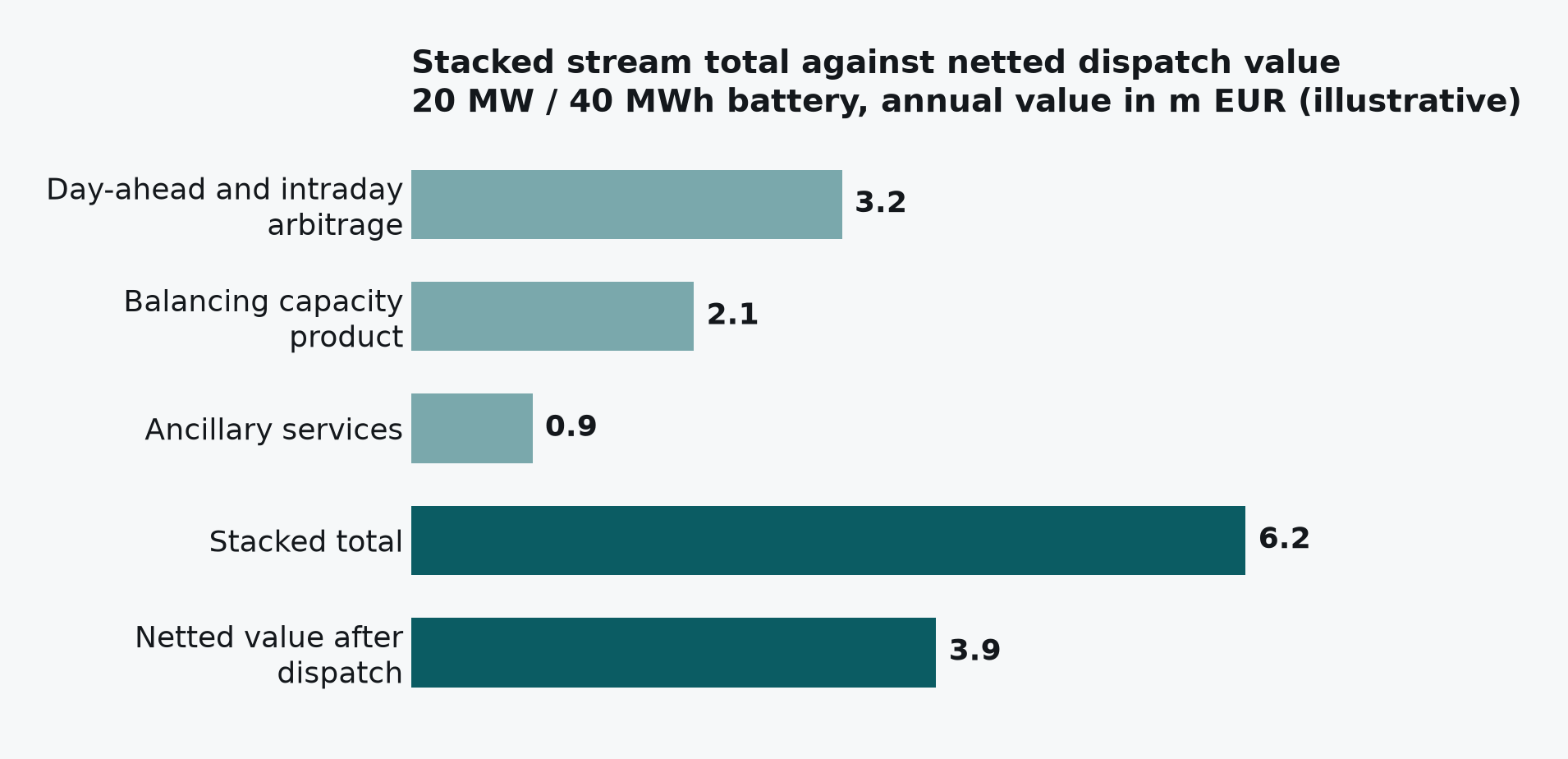
Take a 20 MW / 40 MWh battery. A stream-by-stream case quotes:
| Stream (each valued as if the battery were dedicated to it) | Annual value |
|---|---|
| Day-ahead and intraday arbitrage | 3.2 m EUR |
| Balancing capacity product | 2.1 m EUR |
| Ancillary services | 0.9 m EUR |
| Stacked total | 6.2 m EUR |
Run the same battery through a dispatch that has to pick one use per interval, honours reserve windows once committed, and pays losses and cycle cost. The netted result comes out around 3.9 m EUR. A third of the headline has gone, and it went in the ordinary way: a reserve window that blocked a discharge into a spike, a spike chased at the cost of two extra cycles, an ancillary contract that pinned the state of charge mid-range on a day the spread would have paid for a full cycle.
The netted figure is still well above the best single stream on its own, so stacking is real. It is worth the difference between the netted value and the best dedicated stream, roughly 0.7 m EUR here, a much smaller number than the 3 m EUR of upside the sum implied.
Inside a portfolio
Co-locating a battery with wind or PV adds a further stream, usually called netting: the battery absorbs part of the plant’s forecast error before it reaches imbalance settlement. It is a genuine source of value, and it competes for the same state of charge as everything else. Holding headroom to absorb an afternoon shortfall means arriving at the evening peak less than full. Whether that trade pays depends on how the plant’s forecast errors line up with the hours when the battery has other work, which differs from portfolio to portfolio and has to be answered with the portfolio’s own data.
The useful way to express the whole thing is realized value per MWh of throughput: the net result across every stream after losses, degradation and fees, divided by the energy the battery actually cycled. That figure is comparable across projects and across years. A stacked-stream table is comparable with nothing.
Practical implications
Ask for the dispatch simulation, and ask what constraints it respected, before looking at any stream table. If the case does not say which stream had priority in an hour where two of them wanted the battery, it has not been dispatched.
Compare the netted value with the best single dedicated stream. The difference is what stacking is worth for that project, and it is often smaller than the premium being paid for the flexibility that supposedly enables it.
Treat the cycle budget as a resource that streams compete for across years. The cheapest cycles today may be the most expensive ones to have spent by year eight.
Related reading
- Portfolio Optimization Against Single-Asset Optimization — the same competing-claims logic across assets instead of across revenue streams
- Portfolio-Level vs Single-Asset Optimization — why netting benefits generally, not just inside one battery
- What Realized Value per MWh Actually Measures — the metric a netted BESS value should be reported against
If the investment case for your battery lists each stream on its own line, which of those lines was calculated with the battery already busy doing the others?