Markets
Negative price exposure in German renewable portfolios
Question this page answers How much of a German PV and wind portfolio's value is lost to negative price hours?
The number most often quoted about negative prices in Germany is the count of hours below zero in a year, and that count has risen steeply as PV capacity has grown. It is a useful headline for the market as a whole. For any particular portfolio it is close to useless, because it answers a question no owner is actually asking.
The owner’s question is what negative prices cost this portfolio, and that has two parts the hour count cannot see: how much of the portfolio’s production falls into those hours, and what the portfolio’s contracts do when the price goes below zero. This page works at the level of market structure, because those two mechanisms determine the answer and can be reasoned about before a single price series is loaded.
Negative hours are not spread evenly over production
Negative prices in a renewable-heavy system are caused by renewable output. They appear when wind and solar together exceed what the system can absorb after must-run generation, exports and flexible demand have done what they can. That has an uncomfortable implication for a renewable owner: the hours when the price is negative are, by construction, the hours when the portfolio is producing most.
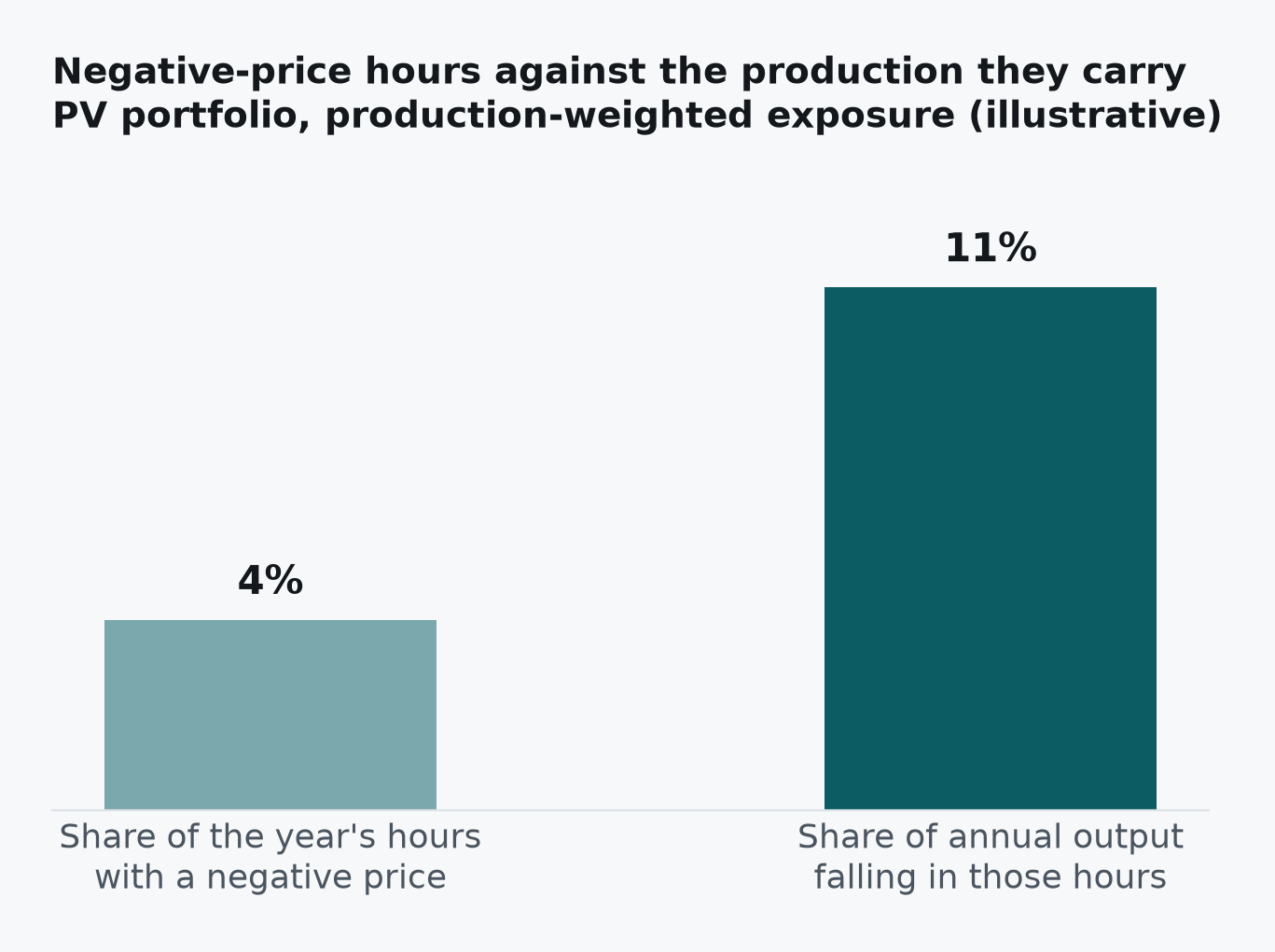
A PV portfolio sees this most sharply. Its negative-price exposure is concentrated in sunny spring and summer middays, which are also its hours of highest output. A simple hour count treats a negative hour at 13:00 in May and one at 03:00 in November as equal. For a PV plant the first might carry several percent of a day’s output and the second carries nothing. Weighting each hour by the portfolio’s own production in it gives a production-weighted exposure, and for solar that figure is systematically and substantially worse than the hour count implies. Wind sees the same effect in milder form, because its output is spread across more of the day and year, though the weighting still moves against the owner.
The consequence for capture price follows directly. Every additional negative hour lowers the average price the portfolio receives by more than the hour’s share of the year, because the portfolio is over-represented in it. This is one of the mechanisms behind the compression of solar capture prices, and it sits entirely outside any single operator’s control.
The contract stack decides everything
A negative price of the same depth in the same hour can be irrelevant to one portfolio and painful to another, depending on how it is contracted. Three archetypes cover most of the ground.
Support that keeps paying. Under older German support arrangements a plant continued to receive its market premium in negative-price hours, at least for shorter negative runs. Such a plant has every incentive to keep producing through a negative price, because the premium outweighs the negative energy price. Negative hours reduce its market revenue and the support scheme largely backfills the loss. Its exposure is limited and mostly administrative.
Support that stops. The German framework has progressively tightened the rule that suspends the premium during runs of negative prices, and the most recent changes leave newer plants with no support at all in any negative-price interval. Such a plant earns the negative price and nothing else if it produces, so producing is a loss. The correct response is to curtail, which requires the technical ability to curtail on a short signal and a commercial arrangement that allows it. A plant that cannot curtail is paying to generate.
Merchant or PPA exposure. A fully merchant plant sits where a plant whose support has stopped sits: it earns the market price, and below zero that is a cost. A PPA changes the picture again, depending on its terms. A pay-as-produced PPA at a fixed price transfers negative-hour risk to the offtaker, who will have priced it in and may have negotiated a floor, a cap on negative-hour volumes or a curtailment right. A PPA floored at zero protects the seller in negative hours and does nothing about the capture-price compression the same hours cause elsewhere in the year. A baseload or shaped PPA pushes the problem into balancing and profile costs.
So “how bad are negative prices for me” has no answer without the contract stack in front of you. Two neighbouring PV parks with identical production and identical exposure to the same hours can have negative-price costs that differ by an order of magnitude, purely because one is supported through those hours and the other is not.
An illustrative framing
The figures below are invented to show the arithmetic. They are not German market statistics and describe no real portfolio.
Suppose a PV portfolio finds that 4 percent of the hours in a year had a negative price, and that those hours carried 11 percent of its annual output. That 11 percent is the exposure that matters. Under a contract that keeps paying, the cost is the negative energy price on 11 percent of output, largely offset by support. Under a contract where support stops and curtailment is possible, the cost is the lost support on that output plus whatever the curtailment itself costs, and the negative energy price is avoided. Under the same contract without the ability to curtail, the portfolio pays the negative price on 11 percent of its production and receives nothing for it. Same hours, same weather, three very different results.
Practical implications
Weight negative hours by your own production before drawing any conclusion.
Map each asset’s contract to what happens below zero: keeps paying, stops paying, floored, or fully exposed. This map, more than any price forecast, determines the exposure and the correct operating response.
Confirm that any asset whose support stops in negative hours can actually be curtailed on the timescale the market moves at, and that the commercial arrangements permit it. The technical ability to stop producing has become a revenue line.
Plan around capture-price compression as a market condition, and work on the gap between that compressed capture price and what the portfolio actually realizes after contracts and curtailment. They are different problems with different owners.
Related reading
- Capture Price Against Realized Value per MWh for PV — the compression mechanism negative-price hours drive
- What Realized Value per MWh Actually Measures — the metric that separates market-wide compression from portfolio-specific gaps
For each asset in your portfolio, do you know today whether it should be running or stopped at 13:00 on a sunny Sunday in May, and does it have the means to do either?